
Gangs Wars: Pixel Shooter RP
playducky.comAction
4.4428.00 Reviews
- Version
- 0.26.18
- Installs
- 10.00M
- Age Rating
- Mature 17+
Screenshots
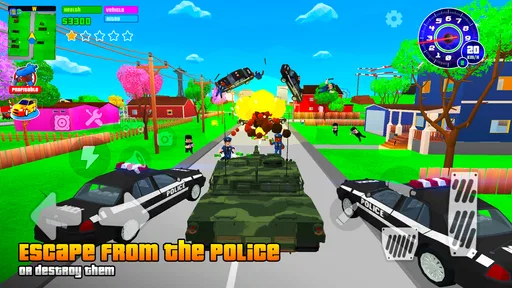
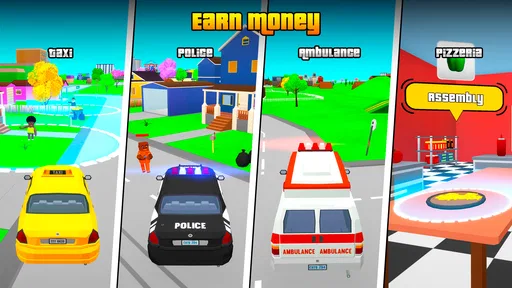
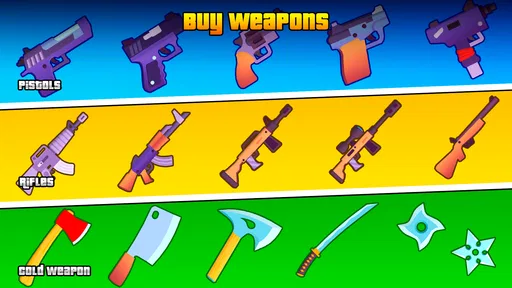
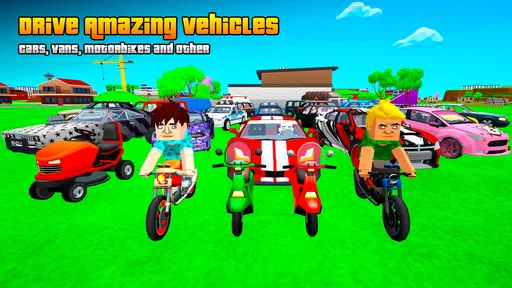
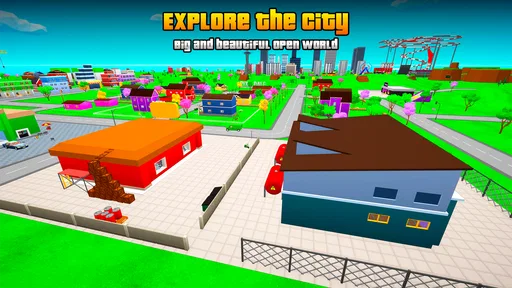
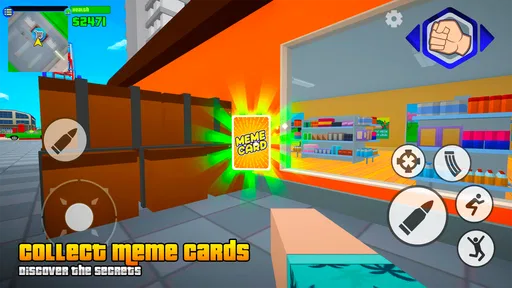
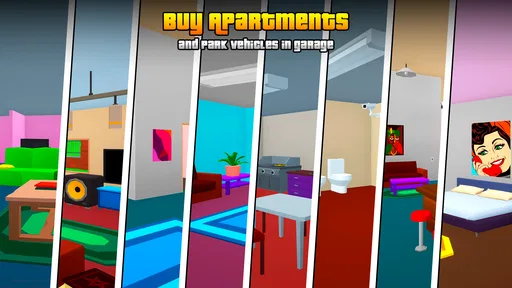
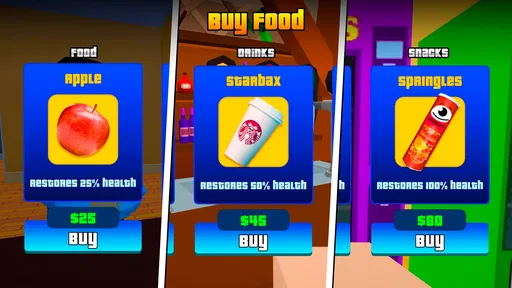
Our Review of Gangs Wars: Pixel Shooter RP
 Analysis by Appyee
I approached Gangs Wars: Pixel Shooter RP expecting a quick blocky shooter, but its identity is a little broader than that. This is an action game built around a gangster-themed first-person view, open-world movement, and a sandbox structure that lets me think about jobs and trouble instead of simply following a straight sequence of levels. The pixel presentation keeps the atmosphere playful, while the mature rating signals that the subject matter is aimed at adults rather than children.
My first impression was that the game is trying to combine three familiar ideas: the immediacy of a mobile FPS, the freedom of a crime sandbox, and the exaggerated look of pixel art. That combination makes it easy to pick up for a short session, but it also means the experience will appeal most to players who enjoy experimenting inside a rough-edged world. If you want a polished, tightly balanced competitive shooter, this is probably not where I would start. If you like wandering, causing trouble, and making your own small objectives, it has a more interesting proposition.
What the game is really offering
The core attraction is the open-world setting. Rather than treating every encounter as an isolated arena, the game presents a space where I can move around and decide what kind of session I want. Sometimes that means focusing on shooting, while at other times the appeal is simply setting up a crime-oriented scenario and seeing how the sandbox responds. That freedom gives the game a different rhythm from a conventional mission-based action title.
The first-person perspective helps keep the action direct. Aiming, moving through the environment, and reacting to threats all feel more immediate when I see the world through the character’s eyes. At the same time, pixel visuals reduce the pressure to take every surface seriously. The result is less like a realistic crime drama and more like a stylized playground where the premise is deliberately exaggerated.
That distinction matters when deciding whether to install it. I would recommend it to someone who enjoys the fantasy of a gangster game but does not need cinematic presentation. The blocky style makes the violence feel visually removed from reality, yet the mature classification still makes it unsuitable for younger players. In a shared household, I would treat that age label as meaningful rather than assuming that the simple graphics make the game family-friendly.
The developer is playducky.com, and the game is free to install. That makes trying it relatively easy, but “free” should not be confused with “without spending options.” The game includes in-app purchases ranging from $0.99 to $64.99 per item. I see that as an important part of the decision, especially for anyone who dislikes games that place purchase pressure near progression or convenience.
The purchase range tells me to approach the economy carefully, without assuming that every player will experience it in the same way. I would begin without buying anything, learn how the basic loop works, and only then decide whether the game provides enough enjoyment to justify spending. That is a better approach here than treating the largest available item as a normal part of the experience.
How progress feels when the novelty wears off
Open-world games can feel generous during the first session because almost every street, encounter, or unusual situation seems worth testing. The more important question is what happens after that curiosity fades. In this game, I would measure progress less by how impressive the opening looks and more by whether the available activities continue to give me reasons to return.
The sandbox format can help with that because it lets me create small personal goals. Instead of waiting for the game to tell me exactly what to do, I can decide to explore an unfamiliar area, attempt a risky crime setup, or practice handling a firefight without immediately chasing a larger objective. This is one of the less obvious strengths of the format: a short session can still feel purposeful if I enter with a simple plan.
A useful routine is to divide a play session into three parts. I might spend the opening minutes learning the nearby layout, use the middle of the session for a deliberate action, and finish by testing how safely I can leave the situation. That approach makes the world feel less random and gives me a way to judge whether the game’s freedom is genuine or merely a collection of disconnected activities.
There is also a trade-off. Player-directed progress can be liberating, but it can become vague if I need a strong chain of objectives. Players who prefer clear missions, carefully staged set pieces, and constant rewards may find the sandbox less motivating than a traditional campaign. I would skip this game if my main requirement were a highly structured story with a dependable sense of escalation.
The offline angle is particularly useful for everyday play. I can imagine using it during a commute with unreliable connectivity, or opening it for a short break when I want an action game without entering a live match. Offline play also changes the pressure around performance: I am not worrying about another player’s connection or waiting for a lobby. That makes the game more suitable for solitary, stop-and-start sessions than for people seeking a persistent social shooter.
Still, offline convenience does not automatically make every session relaxing. A crime sandbox can become hectic quickly, and first-person controls may feel demanding on a smaller screen. I would spend time adjusting my grip and sensitivity before judging the game too harshly. On a phone, tiny corrections matter, and a control setup that feels acceptable in a quiet area may become awkward once several threats appear.
Spending, pressure, and making a fair first decision
The purchase details deserve a careful look because the game is free at the starting point but offers individual items from $0.99 up to $64.99. I would not make a purchase during the first few minutes, even if an offer appears attractive. The sensible test is whether I can understand the basic loop, identify what is actually slowing me down, and decide whether that friction is part of the challenge or a reason to leave.
For a casual player, the lowest-priced option may sound harmless, but small purchases can still become a habit when they are repeated. For a committed player, the highest-priced item deserves even more caution because a large one-time payment can change the value calculation of a game that began as a free download. I would set a personal limit before playing, rather than making that decision while frustrated after a failed attempt.
What I find useful is separating entertainment spending from progress spending. If I am paying because I genuinely enjoy the game and want to support continued play, that is one judgment. If I am paying only because the current activity feels artificially slow or because I want to avoid repeating a task, I would pause. That distinction helps keep the purchase decision under my control.
I also would not assume that paying automatically makes the game more enjoyable. A faster route through a progression system can remove the small decisions that make a sandbox interesting. In a game built around experimenting with crimes and movement, having everything immediately may actually shorten the period when discovery feels rewarding. My advice is to treat purchases as optional conveniences until the game proves that they solve a problem I truly have.
Parents should be especially deliberate here. The mature rating already calls for an age-appropriate decision, and the purchase range means device-level spending controls are worth considering before installation. I would not hand the game to a child simply because the pixel graphics look cartoonish. The visual style and the intended audience are separate issues.
Is the action fair when compared with other shooters?
Fairness is harder to judge in a game whose main appeal is an offline sandbox rather than a clearly defined competitive ladder. The absence of live opponents changes the usual question. I am less concerned about whether another player has bought an advantage over me and more concerned about whether the game lets me understand why I failed, whether controls respond consistently, and whether spending becomes the easiest answer to ordinary obstacles.
Compared with a conventional online FPS, the offline structure is a major advantage for players who dislike competitive pressure. There is no need to compare reaction times with strangers, no dependence on matchmaking, and no worry that a stronger opponent will decide the entire session. On the other hand, online shooters usually provide clearer competitive standards. Their rules, maps, and match results make it easier to tell whether improvement is coming from practice. A sandbox game offers more freedom but less certainty about what “better” means.
Compared with a large open-world crime game, this title is much easier to approach in short bursts and on modest hardware. The pixel presentation keeps the focus on action rather than realism, and the smaller-scale concept is less intimidating than a huge cinematic production. The compromise is obvious: players looking for deep storytelling, realistic driving, or a highly detailed world should choose a more ambitious alternative.
One practical way to judge fairness is to play several sessions without purchases and note the source of each setback. If I lose because I approached a situation badly, that feels like useful feedback. If I repeatedly feel that the only sensible solution is buying an item, I would reconsider the game rather than automatically paying. This simple test is more reliable than judging the economy from one exciting opening session.
I would also avoid comparing the game directly with esports-focused shooters. The goals are different. Here, the appeal is the mixture of first-person action and self-directed criminal scenarios. The game is at its best when I treat it as a personal playground, not as a replacement for a precision competitive title.
Small strategies that make the sandbox more enjoyable
My first practical tip is to learn escape routes before starting a risky activity. In an open-world game, players often focus on the objective and only think about leaving after trouble begins. Spending a few quiet minutes checking turns, open spaces, and nearby cover can make the following attempt feel intentional instead of chaotic. It also gives exploration a clear purpose.
Second, I would avoid stacking every possible risk into one attempt. A better workflow is to test the environment with a modest action, observe how enemies or obstacles respond, and then increase the difficulty on the next run. This is especially useful on a touchscreen, where learning the rhythm of movement and aiming is part of the challenge. It turns failure into information instead of wasted time.
Third, short sessions benefit from a single objective. I might decide to explore one area, practice a weapon encounter, or complete one crime scenario rather than trying to do everything. That prevents the open world from becoming directionless and makes it easier to decide whether I genuinely enjoyed the session. It is a small change, but it suits the game’s offline, pick-up-and-play nature.
A fourth consideration is device compatibility. The minimum operating system is Android 7.0, so anyone using an older phone should check compatibility before planning around the game. Even when an operating system is supported, first-person action can expose weaknesses in an aging device more quickly than a turn-based game would. I would keep other demanding apps closed and test control responsiveness before assuming that a poor first session reflects the game itself.
The current version is 0.26.18, which is useful context when judging how mature the experience feels. I would keep expectations realistic and pay attention to how the game behaves on my particular device rather than assuming that every phone will deliver the same result. For an action sandbox, responsiveness matters as much as the basic concept.
What I would want to know before installing
The game has built a sizeable audience, with an average rating of 4.4 from around 80,000 ratings, and it has passed 10 million installs. Those figures suggest that the premise has reached many players, but they do not replace personal testing. Ratings can confirm that a game is worth investigating; they cannot tell me whether its controls, spending model, and open-ended structure fit my habits.
The store record also shows 428 reviews and a release date of September 2, 2023. I treat that combination as a reminder to read current player comments with attention to context, especially comments about controls, progression, and purchases. A review that praises the game as a quick offline distraction may be more relevant to me than one judging it as a full-scale crime epic.
Would I install it for a child? No. The mature 17+ classification makes that an inappropriate recommendation, regardless of the low-detail art style. Would I install it for an adult who wants a free action game that can work offline? Yes, I would suggest trying it, provided that person is comfortable with optional purchases and an experience that may value freedom over polished structure.
Would I spend money immediately? I would not. I would first establish whether the base game gives me enough room to explore and whether any friction feels reasonable. Since individual purchases can reach $64.99, waiting is not just a financial precaution; it is a way to understand what kind of player experience I am actually buying into.
Would I choose it over a competitive online shooter? Only when I want a solo session. If my priority is measured competition, ranked improvement, or teamwork with friends, a dedicated online FPS would be a better fit. If my priority is creating a small crime scenario, moving through a stylized world, and playing without a connection, this game has a clearer advantage.
My verdict on trust, value, and the right audience
I came away seeing Gangs Wars: Pixel Shooter RP as a game with a specific, understandable appeal rather than a universal recommendation. Its strongest qualities are the combination of first-person action, pixel-style presentation, open-world freedom, and offline suitability. Those elements make it easy to imagine playing for a few minutes while waiting somewhere, then returning later for a more deliberate sandbox experiment.
Its limitations are just as important. The open-ended structure may not satisfy players who need a strong narrative path. Touchscreen shooting can require patience, especially during hectic encounters. The free entry point is welcome, but the in-app purchase range means I would approach progression with a budget and avoid treating spending as the default solution to frustration.
For me, the most trustworthy way to use it is to keep the first phase completely free, set a clear spending boundary, and judge the game by the quality of its offline sessions. If the world gives me enough interesting situations without constant pressure, it earns more time. If I feel pushed toward purchases before I have settled into the gameplay, I would uninstall rather than chase sunk costs.
My recommendation is simple: try it as a free offline action sandbox, not as a premium crime epic or a competitive shooter. Adults who enjoy stylized gangster themes and self-directed play may find a fun distraction here. Players seeking realism, deep storytelling, or tightly controlled multiplayer fairness should look elsewhere. That honest expectation makes the game easier to appreciate and keeps the spending decision where it belongs—with the player.
Verdict
Strengths of Gangs Wars: Pixel Shooter RP
- Retro pixel-art style gives the game a distinctive visual identity.
- Role-playing elements add variety beyond standard shooting matches.
- Short sessions make it easy to play during quick breaks.
- Different gang-themed scenarios help keep the setting entertaining.
- Simple controls are approachable for players new to mobile shooters.
Limitations of Gangs Wars: Pixel Shooter RP
- Pixel visuals may feel dated to players who prefer realistic graphics.
- Progression can become repetitive after extended play sessions.
- Online features may depend heavily on a stable internet connection.
- Touch controls can feel imprecise during fast firefights.
- Mature gang themes may not be suitable for younger players.
Other Releases by playducky.com
View All
Melon Sandbox
Simulation4.7
Similar Picks in This Category
View All
Temple Run 2: Endless Escape
Imangi Studios4.1

PUBG MOBILE
Level Infinite4.3

Free Fire: 9th Anniversary
GARENA INTERNATIONAL I4.4

Talking Tom: Hero Dash Run
Outfit7 Limited4.3

slither.io
Lowtech Studios3.9

Sniper 3D:Gun Shooting Games
Wildlife Studios4.6
Frequently Asked Questions
What is Gangs Wars: Pixel Shooter RP?
Gangs Wars: Pixel Shooter RP is a multiplayer action and role-playing game built around pixel-style graphics, urban gang conflicts, shooting, and open-world interaction. Players can take part in battles, explore the environment, complete activities, and develop their character while interacting with other users. Its role-play elements make it more than a simple shooter, although the experience can vary depending on the online community and available servers.
Can I play Gangs Wars: Pixel Shooter RP offline?
The game is primarily designed for online play because its main features involve multiplayer interaction, role-playing, shared locations, and conflicts with other players. An internet connection is generally required to access the complete experience, synchronize progress, and join online sessions. If you are looking for a fully offline game, this title may not be suitable, and performance can also depend on connection quality and server availability.
Is Gangs Wars: Pixel Shooter RP suitable for children?
Parents should review the game carefully before allowing children to play. Gangs Wars: Pixel Shooter RP includes shooting, gang-related themes, combat, weapons, and interactions with other online players. Depending on the platform and server, chat or user-generated behavior may also expose players to language or content that is not appropriate for younger audiences. Parental supervision and device-level purchase and communication controls are recommended.
Does Gangs Wars: Pixel Shooter RP include in-app purchases or advertisements?
The availability of advertisements, optional purchases, and other monetization features may depend on the version downloaded, operating system, region, and developer updates. Before installing, check the official store listing for current pricing information and purchase details. If the game includes premium currency or paid items, avoid spending simply to progress quickly and review account settings to prevent accidental purchases, especially on shared family devices.
What devices are needed to run Gangs Wars: Pixel Shooter RP smoothly?
The exact requirements can change as the developer releases updates, so the Google Play Store or Apple App Store listing should be treated as the most reliable source for compatibility information. In general, a reasonably modern Android or iOS device with sufficient free storage, updated system software, and a stable internet connection should provide a better experience. Older phones may experience loading delays, reduced frame rates, or crashes.
Play our best games!


